
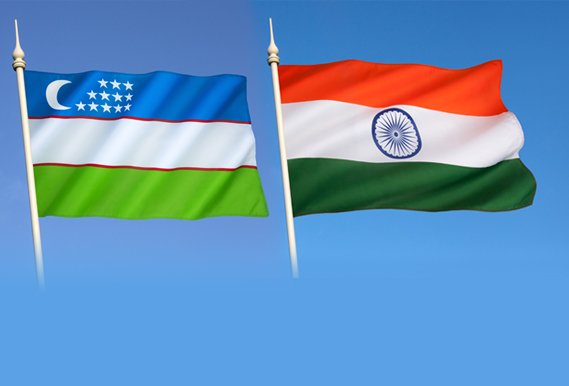
It has been 30 years since the establishment of diplomatic relations between Uzbekistan and India
Relations between Uzbekistan and India date back thousands of years. In modern history, India recognized the independence of Uzbekistan on December 26, 1991. On March 18 of the following year, exactly 30 years ago, an agreement was signed on the establishment of diplomatic relations between the two countries.
In the first year of our independence, India hosted the Days of Culture and Arts of Uzbekistan, dedicated to the 550th anniversary of Alisher Navoi. On the occasion of the first anniversary of our freedom, a festival of Uzbek culture and art was organized in Delhi. In 1993 the 510th anniversary of Zahiriddin Muhammad Babur was widely celebrated in the capitals of the two friendly states.
On the eve of this date, we spoke with Ambassador Abdusamat Khaydarov, Doctor of Political Sciences, Professor of Tashkent State University of Oriental Studies.
– Abdusamat Ahatovich, first of all, as a scientist and politician, can you share your general views on the relations between Uzbekistan and India?
– These two countries are bound by centuries-old historical, scientific, cultural, spiritual and trade relations. The harmony of cultural ties between our peoples is reflected in the invaluable works on the history of the Indian people, such as Abu Rayhan Beruni’s “India” and Zahiriddin Muhammad Babur’s “Mukhtasar or Risolai Aruz.”
Well-known representatives of the Indian people in Uzbekistan are well known, in particular, Vivekananda, Mirzo Galib, Robindranath Tagore, Mahatma Gandhi and others.
Such harmony can be observed not only in science, literature and folklore, but also in medieval Indian architecture, especially in the Taj Mahal ensemble. Cultural and enlightenment ties have been formed over the centuries and permeated all spheres of modern Uzbek-Indian relations.
After gaining independence, Uzbekistan has been operating with unprecedented opportunity for the restoration and development of multifaceted and close relations of friendship and cooperation between our peoples.
The Consulate General of India, which has been operating in Tashkent since 1988, was transformed into the Embassy in 1992. Two years later, the Uzbek Embassy opened in Delhi.
– We are ahead of our neighbors in high-level relations as well …
– You’re right. After the establishment of diplomatic relations, high-level exchanges have significantly improved.
For thirty years, a solid contractual and legal basis for the development of bilateral relations has been created. Since 1997, the Ministries of Foreign Affairs of Uzbekistan and India have been holding regular political consultations to exchange views on regional and foreign policy issues. In 2011, a joint statement on Strategic Partnership was adopted.
– Especially in recent years, bilateral cooperation is developing rapidly …
– Over the past five or six years, our relationship has changed significantly. During the state visit of President of Uzbekistan Shavkat Mirziyoyev to India from September 30 to October 1, 2018, more than 20 documents were signed in the fields of agriculture, science, technology and innovation, space exploration for peace, health and medicine. This laid the foundation for taking our strategic partnership to a qualitatively new, higher level.
On January 17-18, 2019, the Head of our state took part in the international innovation summit “Joshkin Gujarat-2019” to deepen bilateral cooperation.
As a result of these visits, the branches of Amiti University was opened in Tashkent, Sharda in Andijan and Sambhram Technological University in Jizzakh. In July 2020, Tashkent State University of Oriental Studies and Gujarat University of India signed an agreement on the establishment of a dual degree program. Our university was the first university in the CIS to open a joint Indian language program with an Indian university.
A number of research institutes and universities of our country have been cooperating with more than a dozen educational, research institutes and centers of India. These include the Delhi, Pune and Mumbai research institutes.
– Could you also talk about the growth rate of trade and economic relations between our countries.
– According to the Agreement on Trade and Economic Cooperation between our countries, favorable conditions for mutual trade have been created. Regular Uzbek-Indian intergovernmental meetings on trade, economic and scientific-technical cooperation are being held.
At present, there is no direct and secure transport route to South Asian countries to further develop and expand bilateral trade and economic ties. Delhi is seeking to complete the North-South international transport corridor project, designed to provide transport links between India and the Central Asian, CIS and European countries via Iran.
Uzbekistan, along with other countries in the region, supports the project of the Indian side’s access to the Iranian port of Chabahor.
As a result of the mutual interest of both sides in further expanding multilateral relations, a new negotiating platform called Dialog «India-Central Asia» has emerged. It should be noted that the idea of creating this platform was put forward in January 2019 during the first meeting of Ministers of Foreign Affairs of India and Central Asia (including Afghanistan) in Samarkand.
Еру шssues of expanding cooperation between the countries of the Central and South Asian regions were also discussed at the high-level international conference “Central and South Asia: Regional Connectivity, Challenges and Opportunities”, held in July 2021.
At the meeting within the framework of the India-Central Asia Dialogue held in New Delhi on December last year, the Foreign Ministers discussed promising areas of multilateral cooperation and issues of improving the efficiency of economic cooperation, including in mutual trade, industry, investment and strengthening transport connectivity with India. The Uzbek side has proposed to establish a “green corridor” to supply products to the markets of India and Central Asia.
On January 27 this year, at the initiative of the Prime Minister of India Narendra Modi, the first summit of Central Asian and Indian leaders was held in the form of a video conference. At the meeting, the official Delhi stated that it was interested in strengthening cooperation with all Central Asian states.
Another important outcome of the summit was the establishment of a joint working group to promote the use of the Iranian port of Charbahor to promote the “free movement of goods and services between India and Central Asia.”
– Abdusamat aka, we started our conversation with the ancient bilateral cultural and educational ties. Let’s conclude our conversation by informing our readers about the current situation in this regard.
– All right! Cultural ties and cooperation in the field of tourism are important areas of modern bilateral relations. It should be noted that the Indian Cultural Center in Tashkent makes a worthy contribution to the development of our cultural and humanitarian cooperation.
Recently, the Center has been organizing dozens of exhibitions, festivals, meetings with prominent members of the Indian public, scientists and artists.
Masters of Indian art are actively involved in the international music festival “Sharq Taronalari” in Samarkand.
In July 2017, with the support of the Embassy of our country in Delhi, a room of Uzbek language and culture was opened at the Jamia Millia Islamic University, one of the largest universities in India. Here Indian students began to study Uzbek.
The Uzbek delegation took part in the Surajkund Crafts Mela International Festival of Arts, Culture and Crafts in February 2020 in Haryana.
Thus, the Uzbek-Indian relations are successfully developing on the basis of mutual trust and friendship, based on the cornerstone laid by our ancestors many centuries ago.
Abror Gulyamov
International commentator

