A renewed outreach by India to develop closer ties with Central Asia has become imperative. This is important not only by itself in security, strategic and economic terms, but also as an increasingly important element of India’s long-term relations with Afghanistan. As Pakistan’s influence in Afghanistan grows, riding on the back of the Taliban, India needs to further strengthen its links within Afghanistan as also with Iran, Russia and Central Asia. There are clearly significant differences within the Central Asian Republics (CARs) and more so between them and Afghanistan. However, from the standpoint of policy formulation, there is an underlying interlinked, structural coherence for India.
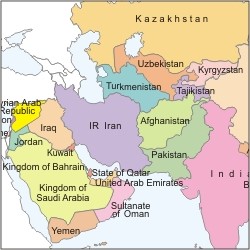
(Source: Maps of India)
To begin by stating the obvious, the CARs are landlocked like Afghanistan; but more importantly, the populations have goodwill towards India and would like to see India more actively engaged as a balancing force. For Afghanistan, the balancing would continue to be vis-à-vis Pakistan, as the Pak ISI seeks to turn Afghanistan into a client state or one where it wields disproportionate influence through its proxy – the Taliban leadership, which it shelters and manipulates. For the CARs, India could be a balancing force vis-à-vis China as the growing economic clout of China looms ever larger over these countries, particularly their fragile economies. It is a given that no sovereign nation wants to be too dependent on another, or have a one-sided relationship that restricts its decision-making ability.
The policy focus for India with regards to the CARs, therefore, suggests itself automatically. The policy most likely to bear early results is one that prioritizes economic relations. To delineate this more narrowly within the economic domain, it would, in a nutshell, be focused on: adding dynamism to business-to-business relations between India and the CARs. And that too quickly as time is of essence. On the face of it, this seems straightforward, but the devil lies in the detail. The constraints are numerous starting with the above-mentioned landlocked nature of the countries impacting a free-flowing trade, and more so the track record has not been noteworthy. In fact, the record of India-aided projects in CARs has been dismal. Overcoming these two constraints relating to: (i) means and ways of transportation; and (ii) efficiency in the execution of joint projects, as we have demonstrated in the past 17-18 years in the case of Afghanistan, hence become critical.
Points to consider, measures suggested:
Facilitation by Indian Missions in CARs and Afghanistan to enable Indian businesspersons to increasingly use Chabahar port in Iran in addition to the Bandar Abbas port. A brief case study as illustration: Flamme Corp has been importing food grains from Uzbekistan to India on a regular basis. In April 2018, it imported two containers of food items to India through Afghanistan trying to avail the services of Chabahar port. However, due to some reason the two containers were detained at the Hairaton border in Afghanistan. When the company head approached (13/04/18) the Afghan Embassy in Tashkent to seek Visa so as to visit Afghanistan and resolve the matter, he was advised to get a supportive letter or a telephone call from the Indian embassy in Tashkent. Unfortunately, he could not be helped by our Mission. Then his local partner, an Uzbek company, approached the Uzbek Embassy at Mazar-e-Sharif. The Uzbek Consulate Head in Mazar promptly visited Hairton Customs and resolved the issue, thereby returning the containers to Uzbekistan. The containers were then routed through the Bandar Abbas route.
The point being highlighted here is that unless the concerned Indian Missions & other offices down the line are sensitized to accord importance to strengthen trade relations in general, and especially to encourage the use of Chabahar port, operationalisation of the port will not be as envisaged. Simultaneously, businesspersons already invested in trading with CARs need to be encouraged by conveying that their trading activities with the region would be facilitated. Institutions such as ‘The India-Central Asia Foundation’ (ICAF) can play a role in facilitating Indian businesspersons, who have trading links with the CARs, by acting as a reliable link with the Ministry of External Affairs and other ministries.
The usual seaport for Indian businesspersons trading with the CARs has been Bandar Abbas. However, due to the U.S. sanctions, its use has been restricted resulting in lower trade volumes with CARs (Indian businesspersons are not being issued BRC – Bank Realisation Certificates – by Indian banks). Chabahar port, on the other hand, is not under U.S. sanctions and is closer to India’s west coast, to ports like Mundra and Nhava Sheva. Chabahar port can in the present circumstances be promoted to access the CARs and beyond, more effectively.
Chabahar’s salience for us increases further in view of the growing Chinese footprint in Iran. It is, therefore, suggested that meetings with a logistics company working in India, Iran, Afghanistan, CARs and Caucasian countries can be held to explore ways to do this. Understanding with the logistics company would not be to manage the port, but only to facilitate inter-country trade using the port. Such an arrangement could help, to a large extent, smoothen frictions relating to trade between India and Iran, India and Afghanistan and India and the CARs.
Due to the ongoing COVID-19 Pandemic, the transportation of goods between the CARs and India and vice versa has become more difficult and fraught. Cargoes between India and the CARs through the sea route have declined sharply. Further, the passenger-cum-cargo flights have almost entirely stopped. To illustrate, the following passenger and cargo flights were in operation till March 2020:
Passenger flights, these also carry commercial goods:
- Tashkent-Delhi-Tashkent (five flights in a week by Uzbek Airways)
- Tashkent-Amritsar-Tashkent (two flights in a week by Uzbek Airways)
- Tashkent-Mumbai-Tashkent (two flights in a week by Uzbek Airways)
- Almaty-Delhi-Almaty (seven flights in a week by Astana Airways)
- Bishkek-Delhi-Bishkek (once in a week, but irregular, by Kyrgyz Airways)
- Dushanbe-Delhi-Dushanbe (once in a week, but irregular, by Tajik Airways)
Cargo flights:
- Tashkent-Delhi-Tashkent, as per need.
All these flights have stopped, except for cargo flights from Tashkent on a weekly basis. Such a dire situation, however, also presents an opportunity to reassess and quickly overhaul trade relations.
As stated above, currently, the favourite route for exports from India to Central Asia is through Iran’s Bandar Abbas port, and from there on via Turkmenistan. The unpredictable nature of dealings at the Turkmen border, as the Turkmen authorities do not provide regular transit passage through railways or roadways, results in cargo loaded in railway wagons and in containers left stranded at the Sarakhs (Iran) – Serakhs (Turkmenistan) Check Point on the Iran-Turkmenistan border.
At the Torkham border post in Pakhtunkhwa (Pakistan) the situation is often much worse. Depending on the ground situation, transit passage for trucks going to Wagah-Attari border check point gets obstructed. Since July 15, a restricted number of trucks (20-25 trucks, mostly carrying black raisins, Liquorice roots or Mulethi, Almonds, carrom seeds, etc.) have started arriving at the Attari border post from Afghanistan. However, this route is entirely dependent on the mercy of the Pakistani authorities, who tend to close it on the slightest pretext.
To avoid such problems, if Chabahar port is promoted and a reputed logistics company involved to tide over the nitty-gritties and paperwork, access to the CARs will become significantly easier. Afghanistan can be a transit point for transportation of goods to the CARs and vice versa. In the process, the Afghan economy gets a boost in the form of increase in transit fees collections. It would also provide employment opportunities to the Afghan people as their help would be required for the trans-shipment process and to handle the increase in cargo.
Onwards from Afghanistan, to CARs and even to Eastern Europe, India can depend on the Uzbek high-speed railway track. Uzbekistan has developed an excellent but little utilised railway track for regular scheduled movement of high-speed freight trains from Tashkent (Uzbekistan) to Hairaton (Afghanistan). From Tashkent, in turn, there is excellent rail and road connectivity to the other Central Asian countries and onwards to Russia and Eastern Europe.
Strategically, use of a Nhava Sheva (or any other Indian port) – Chabahar – Hairaton – Tashkent route would also mean an alternative to China’s ‘One Belt, One Road’ (OBOR) initiative in the region. It would undercut the potential of the Chinese-developed Gwadar port, which is only about 70 km from Chabahar. Easily accessible from India’s western coast, Chabahar would be part of a larger Indian-supported transport corridor. The Indian-built, 193-km Zaranj (on the Iranian border) – Delaram (in Afghanistan’s Nimruz province) highway links up with Iran’s new connecting road from Zaranj down to Chabahar. In addition, India is involved in Chabahar-Faraj-Bam rail link and in a railway from Chabahar to Zahedan, on the Iran-Afghan border.
Chabahar port has not been popular among the Indian business community due to relatively weak logistical services & infrastructure and a lack of dissemination of proper information about the port. As a result, the objectives behind investing in the port have dimmed. To promote Chabahar, therefore, the government could consider giving rebate on transportation using this port. This rebate could be based on the notion of freight equalisation i.e. the freight charges incurred on sending a container (40 feet) from an Indian port, say Nhava Sheva, to Uzbekistan via Chabahar should not be higher than that via the Bandar Abbas route (currently, the freight from India to Uzbekistan amounts to around USD 5000.00). This would be a temporary measure for a few years, and could be discontinued once the traffic through Chabahar increases and logistics efficiency improves. It is quite probable that, over time, transportation of Indian exports and imports to and from the CARs via Chabahar becomes considerably cheaper.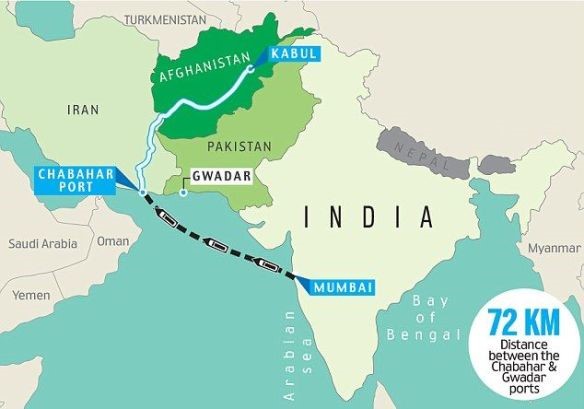
(Source: Chabahar: Gateway to Afghanistan and Central Asia, Brahma Chellaney, The Hindustan Times, April 26, 2018)
Besides promoting and incentivising the sea-road-rail routes using the Iranian ports of Bandar Abbas and Chabahar, the other trading option for India that needs to be developed simultaneously, is the air route. Easy flight connectivity between India and the CARs and creating an Air Corridor, as with Afghanistan, would go a long way in promoting trade between India and the CARs and significantly enhance India’s outreach to the CARs. Establishment of Air Corridors with the CARs can be the quickest way to give impetus to India-CARs trade. The issue of supporting this in the initial period needs to be considered on lines similar to what has been attempted between India and Afghanistan. India along with USAID is providing a special tariff at the rate USD 0.50 per kg for transportation of commercial goods and weekly flights are arranged from India to a number of cities of Afghanistan. A special tariff of USD 1 per kg, for example, could be considered with respect to the CARs.
The CARs could also be considered as preferential bilateral trade partners. This would have a marked impact on trade volumes and India would be able to increasingly compete with China in a number of items in the region. For instance, a recent newspaper article mentioned that mining activity in Karim Nagar (Telangana) was getting adversely impacted due to the absence of Chinese buyers. Karim Nagar is known for Granite mining. Chinese companies purchase Granite Blocks from Khamam, Mattur (Parkasham), Ongal and other locations, and process the material from these blocks in China and then sell it in Central Asia, Europe and the U.S. Value addition in India in the case of such limited natural resources will also add to job opportunities locally besides enhancing trade. Besides Granite, there are other minerals China buys from India, processes these cheaper and then sells in Central Asia and Russia at a competitive price.
In the meanwhile, till preferential/free trade deals are signed, extending trade privileges to the CARs on a mutually beneficial basis could be considered. Such arrangements will act as a pushback against Chinese trade dominance in the region.
Improved access to the CARs would also reduce distortions in trade to the benefit of all partners in the long run. For example, India is importing approximately 500 tons of Asafoetida, in which 450 metric ton approximately is imported from Afghanistan and 50 metric ton is imported from Iran, Uzbekistan, Kazakhstan. Total net Asafoetida crop of Afghanistan was around 50 to 70 metric tons in 2019 and the rest 400 MT was imported by Afghanistan from Tajikistan, Uzbekistan, Kazakhstan, Kyrgyzstan and then imported by India from Afghanistan. For imports from Afghanistan, custom duty is free due to a preferential bilateral trade agreement (Zero duty is paid following issue of Afghanistan origin certificate). So, India is the main buyer of raw Asafoetida (Hing) from the CARs. The average price is around USD 100 per kg and the total import is approximately 500 MT per year. The total value, therefore, comes to around USD fifty million (50,00,0000).
If a preferential trade status is accorded to the CARs, then Central Asian origin goods will start coming directly to India in increased volumes, which will not only boost economic relations with the CARs but also add to revenue earned by Afghanistan, acting as a transportation hub. Similarly, Indian exports of tea, medicines, garments and engineering goods, spare parts will get a boost. With a trade agreement in place, we could also start competing for market share in new areas. For instance, China is the largest exporter of steel to the CARs and Russia. While currently it is difficult for India to compete in this fairly large and growing market due to poor logistics and the levying of production cess and other taxes on steel, if duty drawback is permitted for steel exports to the CARs, at least for five years, Indian steel products can also be expected to gain a significant market share in the CARs and Russia. Some form of restriction on exporting iron ore to China may also help.
An illustrative list of goods exported to CARs from India is as follows:
- Pharmaceutical products
- Mechanical equipment
- Vehicle parts
- Optical instruments
- Surgical instruments
- Surgical accessories
- Refrigerator parts, including for assembling refrigerators in Uzbekistan
- Cosmetics
- Hair oil, Dry Mehndi powder
- Garments
- Fabric
- Marble Slabs
- Granite Slabs
- Chemicals
- Pesticides
- Insecticides
- Animal Feed Soya DOC (De-oiled Cake)
Imports from CARs:
- Asafoetida (Hing)
- Agricultural products
- Green Moong
- Yellow Peas
- Red lentils (Mansoor Dal)
- Kidney beans
- Chickpeas
- Liquorice roots
- Valeriana Wallichi (Tagara)
- Shilajit
- Honey
- Potash (India Imports 9 million tonnes annually, Uzbekistan is one of the largest producers)
- Hydrogen Gas
- Radio Active Elements
- Asbestos
- Precious metals
- Rare Earth metals
- Metal ores
- Ferrous/Non-Ferrous metal scrap
- Skin Hides Raw and Semi Processed
- Animal Guts
- Sheep Wool
- Industrial Chemicals
- Anthracite Coal (High Calorie Coal)
- Dry fruits
- Fresh fruits
There exists potential to procure a number of other products from the CARs, as per market demand. The CARs can provide an alternative for sourcing some metallic and chemical products. For example, newspapers recently reported that Indian air conditioner manufactures have been facing difficulties as most of the components are imported from China, including Compressors and Copper Metallic Tubes, for which we are fully dependent on China. India can alternatively procure these items also from the CARs.
As “CHAMP” (The USAID Commercial Horticulture and Agricultural Marketing Program) is promoting Indo-Afghan business, similarly ICAF, in coordination with the MEA, can play an important role in promoting economic and cultural relations with the CARs. (Business-to-Business meetings are facilitated by CHAMP, supported by USAID and India. It also monitors progress of B2B meetings and tries to resolve outstanding issues between companies.)
In addition to trading activity, an area that has significant potential to further India-CARs ties is the already expanding sector of Medical Tourism. This again is similar to India’s ties with Afghanistan. There exists a big demand in the Central Asian region for specialised medical services that cities like Delhi and Mumbai can offer. Regular flights and visa facilitation for the purpose would help. Another area that could be explored with renewed energy is that of film shooting. CARs are endowed with immense natural beauty and could provide interesting locales at reasonable cost for the dynamic Indian film industry. Tie-ups with various National Film Boards such as the Uzbekistan Film Commission to facilitate shooting of Indian films could prove to be beneficial.
During the course of a renewed outreach, it would need to be kept in mind that the five CARs differ significantly in socio-economic terms, and within a broad policy framework towards the region, India’s relations with each would have to be nurtured separately. Further, a broad understanding with Russia regarding the outreach/initiative would be useful. Geopolitically, among the CARs, Uzbekistan is of critical importance. With President Shavkat Mirziyoyev, the country has started playing a distinctly more open and active role in the region and internationally. Building economic links with Uzbekistan and the other CARs would have strategic bearing, including on our ties with Afghanistan.
Summary: Way Forward
- Issue directives to all Indian missions in the CARs, Iran and Afghanistan to focus on promoting bilateral trade between their respective countries and India and proactively help Indian businesspersons involved in exports to CARs and imports from CARs. Organize Business-to-business meetings biannually at their locations. To check cargoes coming in given the past record of resorting to smuggling, the rate of inspection can be doubled.
- Engage the Turkmen government to facilitate transit of Indian goods travelling between the Iranian port of Bandar Abbas and other Central Asian countries and Russia through the Serakhs Check Post.
- Promote Chabahar as a port of preference to trade with the CARs. Engage a suitable logistics firm at the port to smoothen trade flow.
- Establish Air Corridors between Delhi and Amritsar and the CARs (Tashkent; Almaty; Dushanbe & Bishkek). All these sectors have had regular and chartered flights. A combination of air (for most products) and land-sea-land route (for bulk items such as polished Granite) would be optimal.
- Provide impetus to non-trading areas of economic cooperation such as Medical Tourism and Film making.
- It would be ideal to coordinate India’s renewed economic outreach to the CARs with Russia.
***
(Based on discussion with Indian businessperson Sunil Kumar, Director, Flamme Corporation on the subject on March 7, June 12 and July 31)
Other references:
Chabahar: Gateway to Afghanistan and Central Asia, Brahma Chellaney, The Hindustan Times, April 26, 2018