Background:
Political Pandits (experts) are analyzing recently held presidential elections in the Republic of Kazakhstan. Some call it totally free and fair elections while others have raised some objections. But Kazakh voters have spoken loud and clear for Nursultan Nazarbayev on December 4, 2005. ICAF team was in Astana City as part of “International Observers” for presidential election. On the polling day December 4 2005, we visited four polling stations in Astana City and later in the evening visited polling station number 20 to see the counting of votes.
Polling started at 0700 hour in the morning and continued till 2000 hour in the evening. We arrived at polling booth number 12 in Astana City at 1130 hour. Total number of voters registered at this polling booth was 1445 and by 1130 hour 40 percent had exercised their franchise. Voters used both printed ballots and electronic machines SAILAU. However most preferred printed ballots. Voters were standing in queue and waiting for their turn to cast their vote.
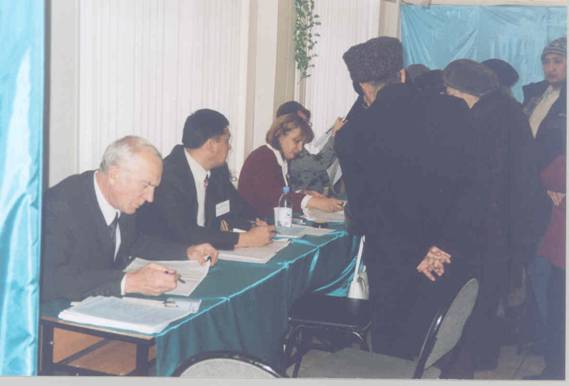
Voting in progress at Polling Station Number 12, Astana City, Kazakhstan
Initially there were eighteen candidates in race for presidential post; however five qualified to contest the elections.
- Alikhan Baimenov- Ak Zhol Democratic Party
- Mels Yeleusizov – Tabigat Movement
- Nursultan Nazarbayev – Otan Party
- Yerassyl Abylkassymov – Communist People’s Party
- Zharmakhan Tuyakbai – For a Fair Kazakhstan Movement
Representatives of the five candidates were monitoring voting process on all polling booths to ensure free and fair electoral process. ICAF team interacted with Candidates’ representative to know their views about the voting process. All of them were satisfied with the arrangements made by the Central Election Commission of the Republic of Kazakhstan. In addition to Candidates’ representatives there were representatives from political parties and public associations as well.
We moved to next polling booth number 13 in Astana City which had 1368 registered voters. We arrived at 1220 hours to this booth and came to know that 571 voters had exercised their franchise; only 107 voters used electronic machines SAILAU. Polling both Secretary Mrs. P L Alexanderovna told us that voters preferred printed ballots more compare to electronic machine. Perhaps they are still not very comfortable with electronic voting.
We talked to some voters outside the polling booth and tried to know their preferences. Many openly supported Nursultan Nazarbayev while some refused to divulge their choice. However all of them were happy with the arrangements made by the Central Election Commission of Kazakhstan.
We decided to go from centre of Astana City to outskirt of the city to see the voter’s response in rural area. It took us 20 minutes by car to reach polling booth number 36 located in Koktal (Green Tree) village. By this time it was 1300 hour. School basketball indoor court was converted into a polling booth which had 2354 registered votes. Polling booth Secretary Mr. Irbul Islamovich Irgebayev told us that 720 voters had exercised their franchise. It was nice to see half of the basket ball court was full with voters. People were waiting for their turn to come. This was like any polling day in Indian rural area. The only difference was that temperature was minus 10 centigrade. Despite such cold weather people were very enthusiastic and warm at heart to use their franchise. One difference seen here compare to other two polling booths (nos. 12 & 13 we visited) was that the electronic voting machines were not used at this booth and voters were very happy to use printed ballots.
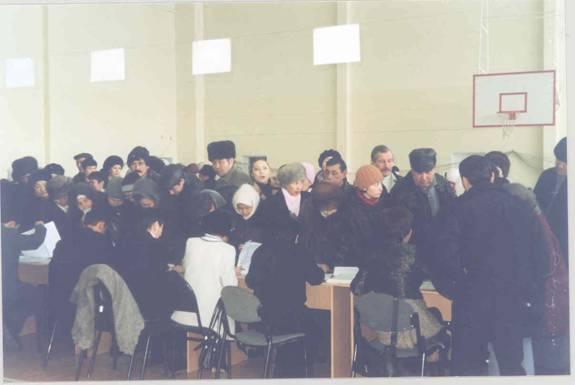
Voting in progress at Polling Booth Number 36, Koktal, Astana City
After warming ourselves with hot food we decided to proceed to polling booth number 157 in Astana City. We arrived at this booth by 1500 h. This had 1271 registered voters and 602 voters had exercised their franchise by this time. Madam L. A. Kuznetsovna, 91 yrs old, World War II veteran came to exercise her vote. It was a treat to talk her and know about the past experiences of her. She was blessing everyone at the booth and praying for the well being of her country and wishing all the best for her leader Nursultan Nazarbayev.
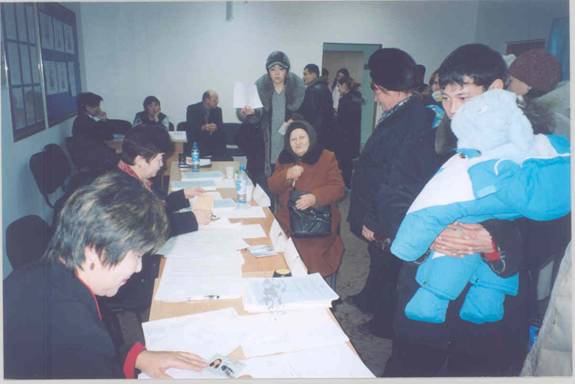
Voting in Progress at Polling Booth Number 157, Astana City, Kazakhstan, Mrs. L A Kuznetsovna, 91 yrs old, (sitting on chair & facing camera) World War II veteran came to exercise her vote.
Analysis:
1277 International Observers and 407 representatives from foreign media witnessed the Presidential Election in Kazakhstan at 9580 polling stations all over the country. Out of a total of 8,874,968 registered voters 6,850, 000 used their franchise in this election, which means more than 77 percent came to cast their vote. Nursultan Nazarbayev got 91.01 percent of the total votes polled while his rival Zharmakhan Tuyakbai leader of “For a Fair Kazakhstan Movement” got 445,047 i. e. 6.64 percent of the total votes polled. Other three candidates performed very poorly. With this landslide victory, Nursultan Nazarbayev would lead his country for another seven years.
Based on our observations at the polling booths we visited, interactions with the representatives of all candidates at these polling booths, Kazakhs voters (academicians, journalists, farmers, intellectual & politicians) and foreign observers who came to monitor Presidential Election in Kazakhstan, we can say that Presidential election in Kazakhstan was free, fair, transparent and accurate.
Why Nursultan Nazarbayev got such a thumping majority? Nursultan Nazarbayev’s victory can be attributed to his ability to maintain stability, inter ethnic harmony and success of economic reforms in Kazakhstan. He got support from all over country north, south, east and west. All nationalities overwhelmingly voted for him. Even in the Kyzylorda region, home base of his main opponent Zharmakhan Tuyakbay, voters’ supported Nursultan Nazarbayev. He succeeded in reaching out to voters and convincing them about his economic and political reforms. He could successfully convey to electorate that his economic reforms are aimed at eliminating poverty, raising the living standard and taking Kazakhstan further in today’s global economy. In his address to the Nation on September 1, 2005 he spelt out his plan of expanding and strengthening democracy at all level. Contrary to this his opponents failed to coordinate their strategy and reaching out to masses. Also opposition was divided house which went in favour of Nursultan Nazarbayev. The main opposition leader Zharmakhan Tuyakbay and Alikhan Baimenov, had nothing substantial to offer to voters. People expressed their faith in Nursultan Nazarbayev because they had seen his leadership and ability to guide their country while maintaining stability, inter ethnic harmony, fighting religious extremism and international terrorism. Presidential Election 2005 is a step forward towards ongoing democratic processes in Kazakhstan.
Dr Ramakant Dwivedi
Strategic Analyst
Astana City, Kazakhstan
December 5, 2005