
ICAF organised one International expedition covering 5500 kms from Kazakhstan to Uzbekistan. ”
The route of the expedition was:
- Astana – Karaganda – Balqash – Taldyqorgan – Jarkent- Khogos (Kazakhstan) – Khorgos (China) – Almaty – (Kazakhstan) –- Bishkek – Osh (Kyrgyz Republic) – Andijon – Ferghana- Kokand – Tashkent – Samarkand – Bukhara – Khiva (Uzbekistan)
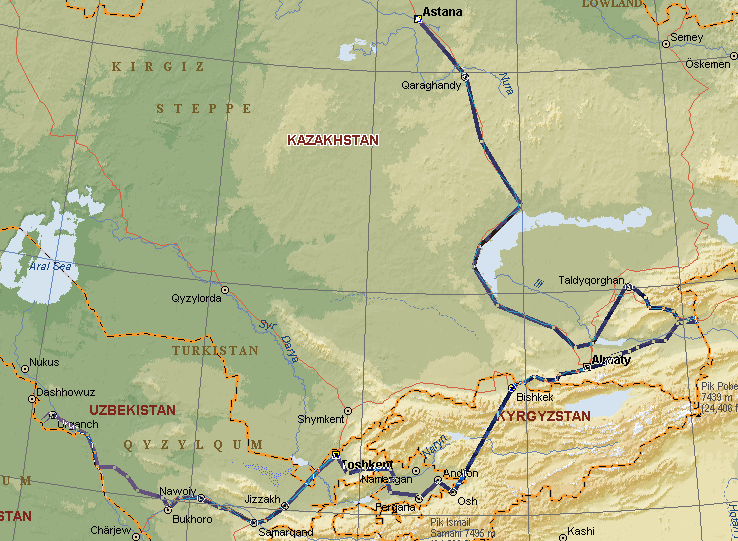
A report on the Expedition through Central Asia organised by India – Central Asia Foundation (ICAF), 18 September – 05 October, 2013
Introduction
1.1 In a global milieu where traditional inter-state diplomacy is often forced to underplay critical dynamics such as the role of culture, education, entrepreneurship and tourism in bilateral ties, there is a need to establish other channels of communication and interactions between States. These are not seen as alternatives but as complementary modules for enhancing cooperation between States. The India Central Asia Foundation’s expedition through Central Asia covering the three countries of Kazakhstan, Kyrgyz Republic and Uzbekistan qualifies as a worthy endeavour premised on this principle of Track II diplomacy.
1.2 The driving expedition through Central Asia was organised by the India – Central Asia Foundation (ICAF), New Delhi during September 18 – October 05, 2013. The 16-member expedition covered 5700 km in three countries – Kazakhstan, Kyrgyz Republic and Uzbekistan in 18 days. The team brought various skills to the venture, from knowledge of the history of the places to politics and economics. It included people who could speak the local languages. The members left New Delhi on September 18, 2013 by Air Astana and reached Astana via Almaty the same day at 2130 h (Kazakhstan time). During the seven day expedition in Kazakhstan, the destinations covered were Astana, Karaganda, Balqash, Taldyqorgan, Jarkent, Khorgos (including Khorgos in Xinjiang province of China also) and Almaty. The next three days (Sept 25-27) were spent in Bishkek and Osh in the Kyrgyz Republic. We covered Andijon, Ferghana, Kokand, Tashkent, Samarkand, Bukhara, Khiva (Khwarizm) and Urgench in Uzbekistan during the next 8 days.
1.3 The members of the team were of different age groups, had varied backgrounds and experience. Generally, we covered from 300 to 500 km between two destinations, covering the distance within five to six hours. The journey between Balqash and Taldyqorgan (800 km), however, took about 12 hours, and that between Bishkek and Osh (700 km) also took the same time. The scenic beauty, however, between Balqash – Taldyqorgan, and between Bishkek – Osh was most enchanting and captivating. The expedition drove on several national and international highways that dotted the ancient Silk Road connecting important cities and offered an insight into their historical, cultural and economic development. In the return journey, we traveled from Urgench to Tashkent by air. The air journey from Tashkent to New Delhi by Uzbek Airways took about three hours, and we reached Delhi on 06 October 2013 at 0330 h.
1.4 The route of the expedition was:
Astana – Karaganda – Balqash – Taldyqorgan – Jarkent- Khogos (Kazakhstan) – Khorgos (China) – Almaty – (Kazakhstan) –- Bishkek – Osh (Kyrgyz Republic) – Andijon – Ferghana- Kokand – Tashkent – Samarkand – Bukhara – Khiva (Uzbekistan)
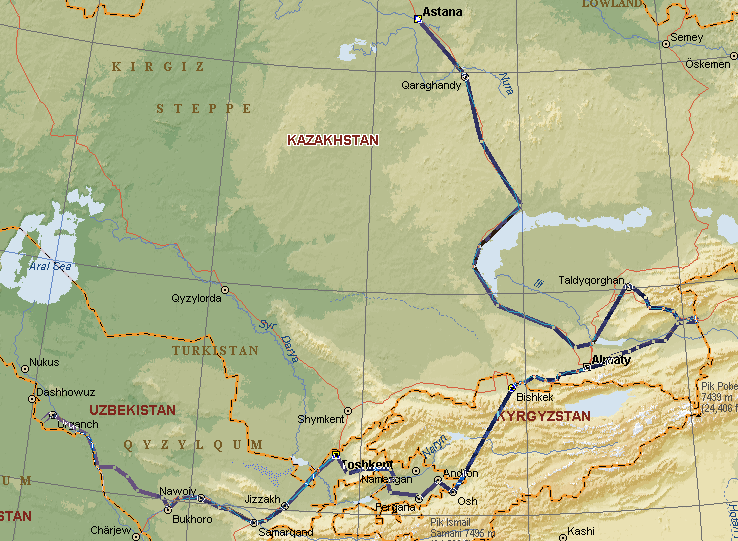
Khorgos, China
1.5 Meetings were held with the following institutions to gain insight into the business and educational potential of Kazakhstan, Kyrgyz Republic and Uzbekistan.
- I. Eurasian National University, Astana, Kazakhstan
II. Centre for Military and Strategic Relations, Astana, Kazakhstan
III. Mittal Steels, Karaganda, Kazakhstan
IV. Kazakh-China International Boundary Centre, Khorgos, Kazakhstan
V. Kazakhstan Institute for Strategic Studies under the President Office of the Republic of Kazakhstan, Almaty, Kazakhstan
VI. Al-Farabi Kazakh National University, Almaty, Kazakhstan
VII. Institute of Oriental Studies, Academy of Sciences, Almaty, Kazakhstan
VIII. Diplomatic Academy, Ministry of Foreign Affairs, Bishkek, Kyrgyz Republic
IX. Kyrgyz-Russian Slavic University, Bishkek, Kyrgyz Republic
X. Osh State University, Osh, Kyrgyz Republic
XI. Babul International Foundation, Andijon, Uzbekistan
XII. University of World Economy and Diplomacy, Tashkent, Uzbekistan
XIII. Al-Beruni Institute of Oriental Study, Tashkent, Uzbekistan
XIV. Mahatma Gandhi Indology Centre, Tashkent, Uzbekistan
XV. Tashkent State Institute of Oriental Studies, Tashkent, Uzbekistan
XVI. Mamun Academy, Khiva, Uzbekistan
XVII. Urgench State University, Urgench, Uzbekistan
1.6 ICAF organised the Round Tables (RTs) with important Institutes/Universities/Think Tanks. These RTs were focused to understand Kazakh, Kyrgyz and Uzbek perspectives on bilateral relations, international terrorism, drug trafficking, religious extremism, State-building & self- governance premised on democratic institutions in Afghanistan with special relevance to the post- US/NATO withdrawal by December 2014.
1.7 A conscious effort was also made to ensure impromptu exposure of the expedition team members to local people in the regions travelled, enriching and enlivening the journey. The landscape through which the expedition travelled offered immense variety from modern cities and towns to barren deserts, steppe, mountains and villages. The vast tree-less steppe, lakes (Balqash), rivers and hills and the Kyzyl Kum desert kept us spell-bound and captivated. Of course, Kyrgyz Republic had no thirsty soil and had abundant greenery full of trees. This was especially so in the Kyrgyz and Uzbek parts of the Ferghana valley.
1.8 A copy of the Expedition Programme, Round Table Programme and Press Coverage are placed at annexure # I, II & III respectively.
1.9 The expedition attempted a sharp focus on promotion of people-to-people contacts between India and countries of Central Asia, assessment of importance of transport corridors, a study of the current interests of India in Central Asia and vice-versa along with promotion of activities towards realization of such interests and increase awareness and initiatives to expand relations between the two regions.
2 Observations on Kazakhstan
2.1 The engagements at Astana encompassed both a ceremonial element as well as the professional and academic ones. The official flag-off of the expedition at the Baiterek Monument followed up by a Round Tables in the Eurasian National University and the Centre for Military and Strategic Relations.
2.2 Director of the Centre for Military and Strategic Relations pointed out that the issues of regional security include religious extremism, food security, situation in Afghanistan (post 2014), cyber security and nuclear proliferation by Iran. It was pointed out that Kazakhstan is keeping a close eye on the Afghan scenario and lauded India’s efforts as the biggest investor in infrastructure development and healthcare. Kazakhs believe that it is post-2014 Afghanistan that poses a threat with a substantively younger population that has to contend with illiteracy and an uncertain future.
2.3 The stay in Karaganda brought two indelible imprints. One is the identity that steel tycoon Lakshmi Mittal’s Arcelor Mittal Industry has established for the old town of Temirtav; and the second, is the possibility that India could fruitfully engage with Central Asia through entrepreneurship. The visit to and detailed presentations at the Arcelor Mittal factory at Temirtav, and the contribution that an integrated steel plant like the Arcelor Mittal enterprise can bring to the local economy was abundantly clear to the delegation at this seemingly sleepy town. One could be accused of a misplaced sense of national pride in considering Temirtav a case of Indian success in Kazakhstan, given the fact that Mittal’s presence and approach has been far more European than Indian and also the fact that barring the top rung of the plant it is essentially a success story crafted by the presence of nearly 26 other nationalities, yet the delegation left Temirtav with a palpable sense of upbeat optimism in the potential of Indian presence in Kazakhstan.
2.4 Beyond Temirtav and Karaganda, the expedition continued along to the town that has developed along Lake Balkhash and then Taldyqorgan. To the Indian delegation, the value of Balkhash town comes from the vast deposit of uranium that the region is known to possess – an interest that is being actively pursued by India. However, there was a quiet around this town. It may not be too farfetched to suggest that it was the solemn silence of a town that had both, failed to capitalize on its value as a tourist locale and had also not managed to diversify its identity and economy in time.
2.5 At Khorgos the international border constructed between Kazakhstan and China was a lesson in foresight and a pragmatic appraisal of the demand-supply dynamics between two countries. Khorgos has developed as an international zone of border trade between the two the countries. The twin construction of a gas pipeline and a cement factory outside the gates of the Centre turned out to be an extraordinarily modest precursor to the story that China is scripting beyond the check-post. The delegation entered the Xinjiang Province of China, briefly, to showcase the leaps of development that the International Cross Border Cooperation Initiative between China and Kazakhstan has been making in this project whose completed version, in 2018, is expected to encompass the international space built through the pursuit of business opportunities in the two countries.
2.6 The trade center is aimed at developing economic, scientific, technical and cultural cooperation between the two countries by attracting foreign and domestic capital. The team had an opportunity to witness, first hand, the kind of developments China is ensuring in remote border towns in return for peace and resources. Khorgos is the only example of a Joint Special Economic Zone (SEZ) by Astana and Beijing, where citizens of both countries can work without a visa for 30 days. It is being built at a cost of 5 billion US dollars, mainly contributed by China. Such a model needs to be carefully looked into by India. As part of our border resolution, China could propose such a model across our northern borders. It’s economic implications, however, merit an in-depth study.
2.7 Kazakhstan Institute of Strategic Studies (KazISS) under the President Office of Kazakhstan was an introduction to the pragmatic conduct of foreign policy which addresses the values of realpolitik and contemporary economic and strategic realities over the traditional affinities and historical orientations. The very succinct enumeration by Dr Bulat Sultanov, Director, KazISS, qualified in no uncertain terms that New Delhi’s lack of a cogent and sustained policy in dealing with Kazakhstan in the real figures of FDI had all but lost the match as a participant in the Kazakh economy. The advice, warranted or unwarranted, was exemplary in its clarity – India needs no longer waste its resources in attempting to break into the Kazakh hydrocarbon sector. It is a game that New Delhi has lost in no uncertain terms. India has to propose high tech investments (IT and other fields) to be considered seriously. These are the sectors in which India may still enjoy an advantage and it should invest more immediately.
2.8 The Round Table with the Institute of Oriental Studies, Academy of Sciences and the Al-Farabi Kazakh National University was co-chaired by Indian ambassador to Kazakhstan Shri Ashok Kumar Sharma. The focus on Indian studies, cultural and social aspects was far more pronounced in these institutes and that explained the differing approach to the delegation’s visit. A remarkable event was the celebration of Hindi Divas at the Oriental Study Centre of the Al-Farabi Kazakh National University. The students not only introduced themselves in Hindi but also organised a dance-drama and poetic shows in Hindi.
2.9 The meetings with various research institutes and think-tanks gave us insights into the thinking of the Kazakh intelligentsia/policy community.
2.10 There is concern on India’s side over the increasing economic and strategic influence of China on Kazakhstan. China is making increasing investments in Kazakhstan and continues to build partnerships across various industries including sizeable investments in the energy sector. China has been successful in building pipelines through very remote regions and barren deserts in order to ensure its access to neighbourhood energy. The peace dividend from such projects is too valuable to be missed.
2.11 In such a scenario, it is important for India to enter certain sectors in a timely manner even though it might not get a big chunk of the cake. Reasonably sized opportunities continue to exist for India in civil nuclear energy and uranium industry. There is ample potential for collaboration in agriculture, education, medicine public health, information technology, culture and defence.
2.12 Scarcity of water is a common problem for Kazakhstan, Kyrgyz Republic and Uzbekistan. Resolution of the water-sharing issue between Central Asian countries will determine peace in the region in future. With major lakes drying up and water salinity, their options are getting restricted.
3 Observations on Kyrgyz Republic
3.1 Kyrgyz Republic is a land-locked country bordering Kazakhstan, China, Tajikistan and Uzbekistan. It is the second poorest country in Central Asia. It has significant deposits of metals including gold. Because the country’s terrain is predominantly mountainous, less than 8 per cent of the land is cultivated.
3.2 Given the state of the Kyrgyz economy and government’s aim towards improving socio-economic standards, there is ample scope for India to explore profitable opportunities in the Kyrgyz Republic.
3.3 Discussions at the Diplomatic Academy proved effective in establishing India’s goodwill in the Kyrgyz Republic. The role of the Shanghai Cooperation Organisation and the viability of CASA-1000’s extension to India and the creation of a trans-national transmission grid formed the mainstay of the discussions at the Academy. The presence of academics and practitioners of foreign policy – both, serving and former – added comprehensiveness to discussions at Bishkek. The takeaway from the Round-Table which the Indian Ambassador to Kyrgyz Republic Jayant N. Khobragade co-chaired was that the Kyrgyz Republic, contra-distinguished to the impression given by Kazakhstan about its expectations, looks forward to India’s active involvement in the country’s attempted growth trajectory. The Kyrgyz Republic has an explicit interest in the creation of job opportunities for its large youth population. India‘s expertise in skill development, language training and the services sector were specifically sought out in interactions.
3.4 A visit to the Osh State University reiterated once more the sustaining ties that India and the Kyrgyz Republic share through sinews of culture and literature. The need for a greater interest in the translation of Kyrgyz literature into Indian languages, as also the need for a more concerted effort in sharing of recent additions to the literary portfolio of India was conveyed. The visit to the University and the gracious attention that the Head of the Institute to answering the query of the delegation, on matters varying from the Kyrgyz Republic’s strategic orientation to the implicit and explicit differences between the capital and the rest of the country, offered valuable insights into the internal dynamics and international ambitions of the country. The unambiguous position of the Institute’s faculty in saying that the Kyrgyz Republic is not a Eurasian State but a Central Asian one was a significant building block to developing an understanding of the county’s world view.
3.5 There are exchange programs in place where Kyrgyz students visit India to study on scholarships. However, our meeting with the India Studies Centre at Osh State University revealed that the University would like to increase the number of students to visit India. Even though providing more scholarships might not be possible, the discussion clearly did reflect potential scope in the education sector between the two countries.
3.6 India was the first country to establish an India Study Centre at the Osh State University. Indian scholars used to teach there. Discussions indicated that a lack of proactive initiative, may be responsible for a stagnating state of affairs at the Indian Study Centre. The faculty was vociferous in inviting a greater interest by India in the functioning of the Centre and exploring the possibility of meaningful collaboration. It was perhaps an exercise in establishing a comparative point that the delegation was intimated about the interest being taken by the Chinese, Korean and US governments in the spread of their respective languages and literature in the institute.
3.7 The post-2014 Afghan situation is perceived as a quagmire that Kyrgyz Republic needs to prepare well. Any instability in Afghanistan is expected to have a spillover into a Kyrgyz territory which is rendered vulnerable due to persisting economic weaknesses and religious extremism.
3.8 Kyrgyz Republic seems to be way ahead of the rest in Central Asia in terms of freedom of expression. At the Diplomatic Academy RT in Bishkek, there were sharp differences of opinion on the role of the Shanghai Cooperation Organization. There were different perceptions of the situation in Afghanistan as well. One of the speakers staunchly supported re-integration of Taliban in Afghan society and a role for them in the Afghan government after US withdrawal next year. The Rector of the Osh State University was candid in expressing his uncertainty about the future relevance of the Manas Facility Centre after the USA leave Afghanistan, they would not need to transit through the Manas.
4 Observations on Uzbekistan
4.1 There was apprehension about crossing of the border into Uzbekistan since the very start of the expedition. However, when it finally did happen there were no glitches and it was once again an instance of the idea of exotic-old-friend-Hindustan working in our favour. The tandem of history and the legacy of a cultural heritage with India is taken very seriously by Uzbekistan. The goodwill for India and the idea of the Indian civilization was overwhelming right through Andijon, where the final leg of this expedition commenced, to Khiva where the expedition concluded.
4.2 Uzbekistan is one of the two doubly land-locked countries’ in the world. Its economy relies mainly on commodity production – cotton, gold, uranium and natural gas. It has the fourth largest gold deposits, tenth largest copper deposits and twelfth largest uranium deposits in the world.
4.3 The bulk of the nation’s water resources are used for farming. The region near the Aral Sea sees high salinity and contamination of the soil with heavy elements. Heavy use of pesticides and fertilizers for cotton growing further increases soil pollution.
4.4 The government maintains tight economic controls which deter foreign investment and imports. Unofficial discussions with locals also revealed that the government does not allow development of an independent private sector.
4.5 There already exists a reasonably favorable export-import trade relation between India and Uzbekistan (cotton, leather, pharmaceuticals etc). There are possibilities to enhance Indian investments in Uzbekistan in the fields of tourism, agriculture, trade, textiles and pharmaceuticals.
4.6 While discussions at the University of World Economy and Diplomacy did focus primarily on the days of yore and the connect through Babur and Mughal dynasty, there were substantive discussions about Uzbekistan’s regional role as a large State and the threat to its stability in the face of rising concerns about the spread of Islamic fundamentalism. The naturally expected concerns that stem from the withdrawal of US/NATO forces from Afghanistan in 2014, formed an important area of discussions. Significantly, despite the substantial amounts of goodwill exuded by the populace and members of the academia and the policy community towards India, in an exposition about Uzbekistan’s foreign policy priorities both in terms of potential and problem India did not find a place.
4.7 Uzbekistan seems to have brought the Islamic Movement of Uzbekistan (IMU) problem under control. But Andijon, Namangan and Ferghana provinces adjoining Kyrgyz seem to be more conservative than the rest of the country. So any turmoil in Ferghana Valley will again have a cascading effect in Central Asia.
4.8 A visit to the South Asian Studies Center and the Mahatma Gandhi Indology Center was impressive in terms of the interest shown in the study of India and Indian languages. The faculty, while speaking of the great fondness for all things Indian, did lament the lack of a pro-active involvement of New Delhi in the furtherance of Indology. It would perhaps not be misplaced to suggest that it was a feeling of negligence that led the faculty at the Center to draw a comparison with involvement and grants the Chinese government was consistently making towards the study of their country in Uzbekistan.
4.9 The expedition attended a public function commemorating the birth anniversary of late Indian Prime Minister Shri Lal Bahadur Shastri at the Shastri Park on 02 October before leaving for Samarkand.
4.10 At Samarkand a visit to the Afrasiab exacavation sight was quite educational. The nearby Afrasiab museum has some of the world’s renowned paintings in the ‘Hall of Ambassadors’.
4.11 The last leg of the expedition was conducted at the World Heritage Site of Ichon Kala at Khiva and to see the Khans of the Khiva Khanate, the madrassas have turned into handicraft centres, various palaces decorated with majolica tile work and the beautiful minarets of the township.
5. Observations on Associate Issues
5.1 Afghanistan has very often been perceived as a ‘bridge-buffer’ and a ‘shatter-zone’ and has, consequently, been viewed in accordance with this understanding. Kabul and Kandahar have also been the staging point of most conflicts that have shaped the destiny of the region. Ethnicity introduced along with the attendant problems and aspirations compounds the tragedy of Afghanistan further. The withdrawal of ISAF would impose an added pressure on India with the challenge to take up the cause of its extended neighborhood.
5.2 The hostile attitude of Pakistan and continued turmoil and instability in Afghanistan, the shortest land route from India to Central Asia across Pakistan and Afghanistan is not available to India so far and may not be available in the near future. The other two routes for sending cargo from India to Central Asia are long and circuitous. These are, one across China and the second is the northern route across Russia. These routes pass through half the globe in order to reach Central Asian States that are just at two to three hours flight from India. Chabahar port of Iran is of immense importance for transport links among India, Iran, Afghanistan and Central Asia. Chabahar port is located at a distance of 72-km from Pakistan’s China-built port of Gwadar. It is nearer to the Indian shores than Iran’s main port –the Bandar Abbas. Moreover, to avoid Bandar Abbas becoming over congested, Iran wants to develop Chabahar for trade with Central Asia and Afghanistan, and keep Bandar Abbas for trade with Russia and Europe.
5.3 In January 2003, India, Iran and Afghanistan signed in Tehran a MoU on the Development and Construction of the Transit and Transport Infrastructure with the intent of improving the route from Chabahar port to Milak and the western Afghan city of Zaranj in Nimroz province. The 215-km long costing $136 million Zaranj-Delaram road –in the construction of which India made huge sacrifices in life at the hands of Taliban militants—is further linked with the ‘Garland Highway’ in Afghanistan, which connects all the major Afghan cities. Zaranj-Delaram road was completed and handed over by India to Afghan government on January 22, 2009. The ‘Garland Highway’ in the north connects Herat with Kabul via Mazar-e-Sharif. In the south Kabul is connected with Kandahar. Delaram is located between Kandahar and Herat. Recently Mazar-e-Sharif got connected with Uzbekistan by railway.
5.4 The leadership in these countries is taking great personal interest in establishing new museums and rewriting of history. Cultural linkages with India so much so Silk Route configuration seems to be hijacked showing China linkages prominently and forgetting that Pakistan has come up as a land barrier only in the recent past.
6 Recommendations:
6.1 Even though semi-regular talks and meetings continue to take place between governmental and non-governmental organizations from both India and Kazakhstan, there needs to be a dedicated effort by the Government of India to increase focus on this region and support Track II organizations in order to increase the frequency of dialogue between the two nations.
6.2 The current scene of events, though promising, lacks consistency. Meetings to discuss opportunities need to take place more often and delegations should be sent out at regular intervals to follow up and explore newer opportunities. Efforts should be made towards decreasing the time gap between each face-to-face follow up. Expeditions as this one should be a regular feature and be undertaken at least every alternate year.
6.3 The trade center established primarily by China at Khorgos on the Kazakh-China trade corridor at a cost of 5 billion US dollars is ostensibly aimed at developing economic, scientific, technical and cultural cooperation between the two countries by attracting foreign and domestic capital whereas it certainly will ensure dumping of Chinese goods into this region and even Europe through the east-west transit corridors. The team had an opportunity to witness firsthand the ongoing construction of trade centers, shopping malls, hotels, casinos etc. Khorgos is the only example of a joint special economic zone (SEZ) by Astana and Beijing, where citizens of both countries can work without visa for 30 days. China could probably propose such a model across India’s northern borders during border resolution talks eg, at Nathula for trade through Sikkim and on to Bangladesh and Bay of Bengal. Its economic implications, however, merit in-depth study.
6.4 Given Kyrgyz Republic’s significant metal deposits, mineral exploration and development opportunities could be a rewarding avenue for India to explore. Additionally, Information Technology, Science & Technology, healthcare, tourism, education and culture are also sectors that should be explored by India. Keeping in mind that the Kyrgyz Republic is in need of an economic revival, the public and private sectors are expected to be on the lookout for opportunities to set up industries in the country. With the hope of employment creation, the Kyrgyz government might be open to providing trade benefits to countries that make investments in the nation.
6.5 After US withdrawal from Manas Air Base in Kyrgyz Republic, it is likely for economic reasons to be made into an International Facility Centre and diplomatic hub including embassy locations. India may find it pragmatic to establish substantial presence at the Manas Facility Centre because of its strategic location for gathering of intelligence and proximity to a alternate air field.
6.6 The difference in the perception that Kazakhstan and Kyrgyz Republic have, at least in their avowed positions, about China’s influence and involvement is an area that substantive academic and policy research needs to concern with.
6.7 Uzbekistan has grave concerns on the post-2014 situation in Afghanistan. Though its own border with Afghanistan is well guarded by its army, it is worried about the indirect threat via its borders with Tajikistan that are mountainous and difficult to guard. However, it publically articulates an approach (in fact all the CARs do the same) that it shall interact with the post-2014 elected governments in Afghanistan to resolve emerging problems. This suggests that the pre-US involvement alliances may be necessary once again to check the Taliban from spreading northward into Central Asia.
6.8 Given the Uzbek government’s tight stand on economic regulations, the Indian private sector might face problems in Uzbekistan. The government’s affinity to discourage independent private sector growth could also prove to be a deterrent. However, further growth opportunities lie in the public sector such as education, textiles, leather, pharma, construction and tourism. There is also a small potential in agricultural and environmental science academic/research programs given Uzbekistan’s soil problems/salination.
6.9 Chabahar route provides an alternative outlet to the sea to landlocked Afghanistan and CARs (Central Asian Republics) besides the Pakistan option. It provides a route to India to reach Afghanistan and Central Asia as the Pakistan route is still not available for transit of Indian goods. India, Iran and Afghanistan have signed an agreement to give Indian goods, heading for Central Asia and Afghanistan, preferential treatment and tariff reductions at Chabahar.
6.10 There is a declining interest on India in Central Asia as depicted in various museums and discussions. Linkages with Indian history courtesy Babur and others though a significant issue in discussions, find nearly nil representation in the Museums and historical publications. So much so that the Silk Route configuration to India seem to be hijacked showing prominent China linkages and ignoring that Pakistan has come up as a land barrier only in the recent past. Government may like to strengthen the Centres dedicated to study Indian society, culture, history, economy and politics at Almaty, Bishkek, Osh and Tashkent to reinforce our cultural and historical linkages.
6.11 The teachers of the Mahatma Gandhi Indology Centre in Tashkent highlighted the need for undergoing refresher courses in India. The genuine requirement of the Centre and other facilities that concern itself with a serious focus on Indology must be taken up by the Government of India.
6.12 Discussions with the local community and academic indicates an interest and receptiveness to involving India in the sectors of agriculture, pharmaceutical, tourism, water system sciences, the service sector and skill development. It is an opportunity to be availed.
6.13 The Bollywood magic is universal in these countries. In the remote town of Taldygorgan in Kazakhstan, a birthday party was celebrated with a disco dance on the tune of “I am a disco dancer”. At the Al-Farabi Kazak National University, the students celebrated Hindi Diwas by singing Bollywood songs, dancing on Bollywood songs and enacting a Hindu wedding to the tune of a Bollywood song complete with seven rounds an electric fire and throwing money at the newlyweds. At the Lal Bhadur Shastri Centre for Indian Culture in Tashkent, we were welcomed by Uzbek young men and women in Indian clothes who later performed dances on Bollywood songs. We must exploit this source of our soft power to the fullest. That, of course, should not take away from our efforts to introduce and project our other performing and visual arts, crafts and literature.